Munich has everything – except affordable rental space. That’s why it’s often difficult for artists and creative professionals in the city to tinker with their ideas and experiment without feeling pressed for time. A new haven is the Kreativquartier, where living, art and work come together and thoughts are given free rein.
What a luxury: Lots of expensive space is reserved for ideas and projects in the middle of Munich. An urban district is being created on the land between Dachauerstrasse, Lothstrasse, Schwere-Reiter-Strasse, Hessstrasse and Infanteriestrasse, where living and work can combine with art, culture and knowledge. The 20-hectare area is located near the Olympiapark (Olympic Park) between the popular districts of Schwabing and Neuhausen.
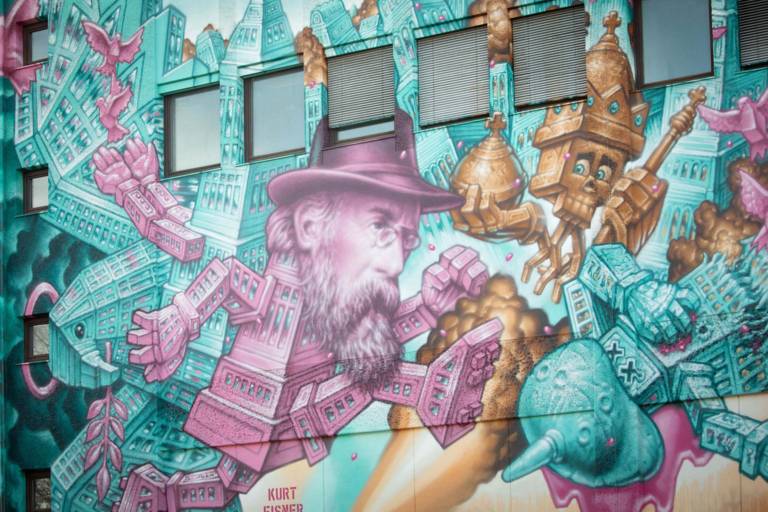
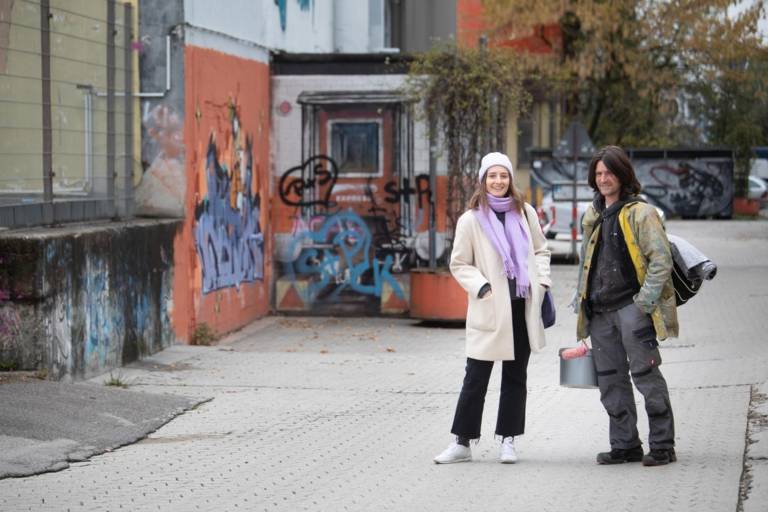
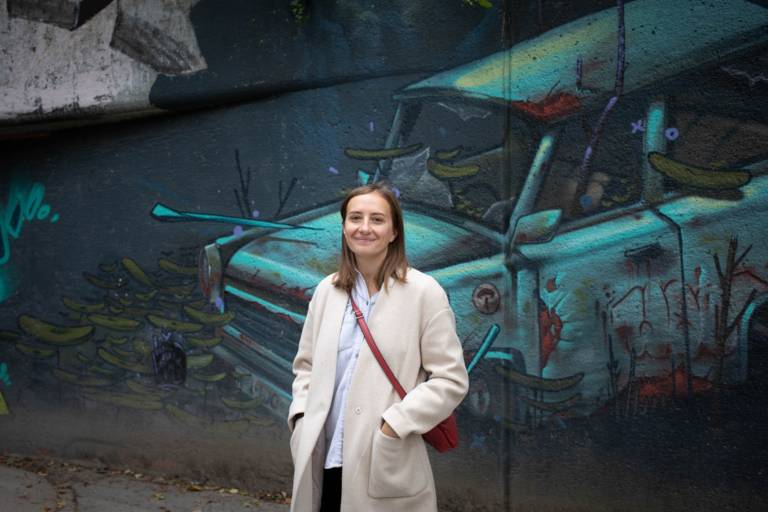
The cityscape is quite surprising here, featuring old industrial buildings, graffiti and overgrown gardens. Graphic artists and advertisers bounce around ideas during a picnic on the lawn, while others enjoy their lunch break on benches in the sun – it’s an inspiring atmosphere.
A lot is still in the pipeline – but there’s already plenty going on in parts of the neighbourhood: performances, exhibitions, workshops and concerts are already being held all over the site. There are art studios, open workshops and design studios. Actors and actresses rehearse on stages – and, since 2021, also in the neue schwere reiter theatre – and stage their productions there.
In 2011, the Munich Urban Colab start-up and innovation centre was opened, where established companies, start-ups and Munich City Council work together on sustainable solutions for a liveable city of the future.
It is, therefore, a vibrant, creative scene that also inspires visitors to think in new ways. Nevertheless, no living space is being wasted here: construction has already begun on at least 820 flats, and a primary school, a new university building and public green spaces are set to follow. Work has also begun on the restoration of the listed industrial heritage sites, the Jutier Hall and the Tonnenhalle. In the near future, they will serve artists, cultural practitioners and Munich’s creative industries.
In detail, it looks like this: the Kreativquartier is divided into four areas, known as the Kreativpark (Creative Park), Kreativlabor (Creative Lab), Kreativplattform /Creative Platform) and Kreativfeld (Creative Field). The aim is to bring together living, working, art and science in the most liveable and profitable way possible, with unlimited opportunities for collaboration, exchange and inspiration.
The cross-sector innovation hub Munich Urban Colab opened back in 2011 in the Kreativpark, between Heßstraße and Dachauer Straße. Certain areas, such as the on-site café, are open to the public, and there are also regular free events and discussion forums for anyone interested in a liveable city of the future. As part of the ‘Open Workshop’ initiative, members of the public can also hire space in the well-equipped, high-tech MakerSpace workshop.
Renovation work on the Jutierhalle and Tonnenhalle is currently still underway in the immediate vicinity. Once completed, the listed Tonnenhalle will offer plenty of space for concerts, performances and other events. Dance studios and catering facilities are also planned. In the Jutierhalle, an industrial hall from the 1920s which is also a listed building, 60 so-called studio and work modules are being created for artists, designers and many other creative professionals.
The adjoining park, which covers an area the size of two football pitches, is set to become a place for relaxation, socialising and creative breaks, featuring spacious lawns, a sunbathing area, several playgrounds and numerous small sports facilities. First and foremost, of course, it also serves as a local recreational space for residents of the creative quarter. The park connects the Creative Park with the Kreativlabor, with its urban mix of uses comprising culture, the creative industries, housing, social services, commercial premises and retail outlets in both old and new buildings.
A children’s centre – that is, a municipal nursery – and 79 flats are being built there, with potential for more. Numerous long-standing institutions, such as Import Export – renowned far beyond Munich’s borders for its concerts – Pathos, a hub for Munich’s independent theatre scene, and Halle 6, a venue for contemporary art across all disciplines, are located here.
For the Kreativplattform in the southern part of the site, the Hochschule für angewandte Wissenschaften (University of Applied Sciences), which is based in the neighbourhood, is gaining an additional campus. In addition, new buildings with around 395 flats are being constructed, as well as another children’s centre.
The site of the former Luitpold Barracks is being transformed into a Kreativfeld – or, more precisely, a green residential, working and educational area. Here, the city plans to build 325 flats, a primary school and another children’s centre.